Blitz Memories
By Iain Talman

– 4 min read
By Iain Talman

As shared by James Maghie Talman 19/7/1913 - 3/1/1990
Dad worked in the drawing loft of Hamiltonʼs Glen Yard in Port Glasgow and after time at Art School worked in the Display Department at Wyllie & Lochhead.
He joined up before the Second World War started in the hope of getting a safer number which came in the form of a Cameronian Battalion converted to an artillery regiment or more specifically a searchlight regiment.
In the first air-raid on Britain, they defended the Forth Bridge with First World War Lewis guns. Searchlights were of little practical use and they were converted again to 125 Light Anti-aircraft Regiment, Royal Artillery.
Promotions followed to Lance Bombardier, Bombardier and Sergeant. He began specialising in aircraft recognition and became an instructor. I still have a Bakelite model Bristol Beaufighter.
It was one of the most easily recognisable being the only twin engine with the engine nacelles going further forward than the nose.
Wing shapes were almost as important as general confirmation.
Engine sound was also important. He could long after still mimic these, including the distinctive pulsating of the Heinkel and the rise and fall of the Dornier. This was a vitally important skill so that the wrong aircraft did not get shot down.
He rose to bombardier.
Here he is as such, looking utilitarian as opposed to the more dashing Scottish Horse yeomanry uniform of two ranks lower, brother Gunner John.
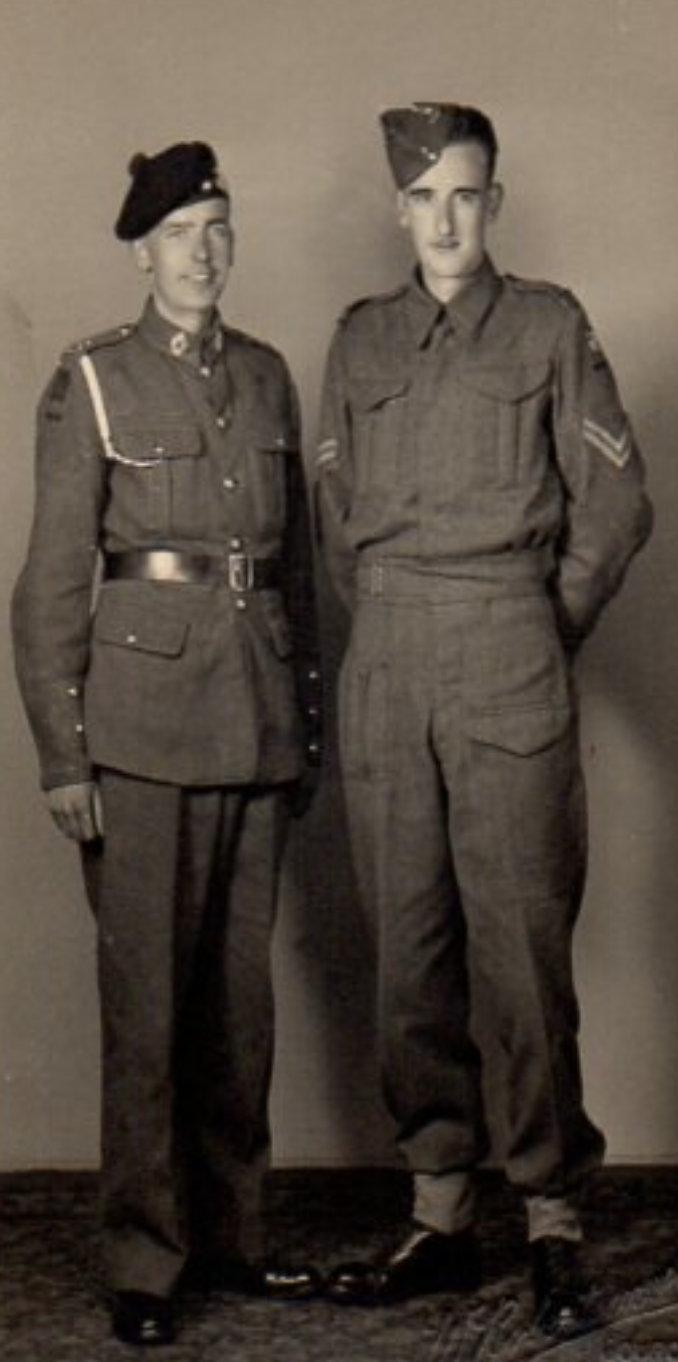
March 1941
Dad later rose to sergeant.
However, before that they were already operating anti- aircraft guns. They had been stationed somewhere up Loch Lomondside when, shortly before 13th March, they and other units were ordered down to Clydebank.
Apparently, the authorities knew something was coming but the town was not evacuated.
Could it have been evacuated? To where? Would it have caused more panic? Anyway, the shipbuilding and engineering town of Clydebank, Dunbartonshire, just along the north bank of the Clyde, west of Glasgow was bombed by the Luftwaffe on the nights of 13/14 and 14/15 March 1941.
As a result of these raids the town was largely destroyed and it suffered the worst destruction and civilian loss of life in all of Scotland - 528 people died, 617 people were seriously injured, and hundreds more were injured by blast debris.
Out of approximately 12,000 houses, only seven remained undamaged — with 4,000 (including some whole streets) completely destroyed and 4,500 severely damaged.
Over 35,000 people were made homeless.
Most Cataclysmic Event
Clydebank's production of ships and munitions for the Allies made it a target. Major targets included the John Brown & Company shipyard, Royal Ordinance Factory Dalmuir and the Singer Corporation factory (on munitions work).
A total of 439 bombers dropped over 1,000 bombs. RAF fighters managed to shoot down two aircraft during the raid, but none were brought down by anti-aircraft fire.
Dad saw not only “ack-ack” fire from his and other batteries but also warships in the docks and dockyards.
In his book Luftwaffe over Scotland: a history of German air attacks on Scotland, 1939- 45, amateur historian Les Taylor qualified the Clydebank Blitz as "the most cataclysmic event" in war-time Scotland.
He claims that while the raid on 13 March was not intended as a terror attack, it caused extensive damage because there was a lot of housing near the specific targets.
But the bombing the following night was indeed a terror attack as it "was intended to crack morale and force the people to call for an end to the war. However, it had quite the opposite effect, strengthening resolve for the war in Scotland.”
Move to Safety
Our friend Cathie McMillan had spent the Blitz in an Anderson Shelter with bombs going off all around outside.
Her father, a shipyard worker, was eventually called on to help the rescue efforts when the bombing had finished. She tried to stop him going but realised he had to.
She found it terrifying.
Someone else had to move to safety. As she walked along the street the floors of a tenement with furniture and entire contents collapsed to the ground and shot out into the street through the shop-front windows on the ground floor.
Dad did not have the luxury of an air-raid shelter.
He was outside commanding an anti-aircraft gun (what sort I do not know; it seems to have been a large enough one, although it was a light anti- aircraft regiment) dug into a pit.
It must have been like hell on earth those nights in Clydebank.
Recognition Skills
Dad saw something coming down on a parachute and realised it was a land mine. He ordered the gun to engage and it blew up in the air with a huge explosion.
He came to again with him and the other crew all blown out of the pit, and with blood coming out of every orifice.
Soon after his aircraft detection skill was put to the test on the night of 10/11 May 1941.
Stationed somewhere in the Lowlands, he reported a Messerschmitt 110 (a twin- engine fighter) going over.
He was told to brush up on his recognition skills because a 110 did not have range to fly from Germany and back; but he was indeed right.
Other such reports were made in Scotland and England by military and Royal Observer Corps outposts.
It was Rudolf Hess, Deputy Fuhrer, on his solo mission to reach the Duke of Hamilton, possibly with a view to treating for peace. He parachuted into a field near Eaglesham and surrendered to a local farmer.
I am told by an Eaglesham resident the farmer made money long after describing his capture at pitch-fork point(s) – and then persuaded (at a price) to part with the “very pitch-fork” several times over.
After other adventures, including at Rosneath, my father went on to take a commission. He was seriously wounded in Normandy, spending several years in hospital.
I still have his red and blue forage cap although itʼs more than a little faded now. His sergeantʼs gold stripes survived many years but could not be found after he died.
Become a Clydesider member here: https://www.clydesider.org/#/portal/signup