Finding Our Industrial Heritage in the Vale o f Leven
By Jeremy Watson

– 4 min read
By Jeremy Watson
All those dates and names made history dry and boring for me at school, but over the decades I changed my mind.
I discovered History is Like Completing a Puzzle or Solving a Mystery. It is amazing what you can find once you follow the clues.
Signs of our once proud and vibrant industries within the Vale of Leven are all but gone, but they do exist.
For this article I am concentrating on just one small part of West Dunbartonshire – the area around the Stuckie Bridges across the Leven and the Croftengea lade.
The Vale of Leven was once an area of intense industrialisation concentrating on the manufacture, printing and treating (eg bleaching) of textiles. We can count 12 different works (13 if you count two that merged).
You will no doubt have heard of ʻTurkey Red.ʼ
That name conjures up images of turkeys, or at least the country of that name. Neither of these are accurate.
Turkey Red is a dyeing method widely used in the 18th and 19th centuries to give cotton a distinctive bright red colour.
It was made using the root of the madder plant, which came from the country of Turkey, but the laborious processes were developed in India and China.
What we did was the sourcing of raw materials from elsewhere in the British Empire, processing the products and then exporting them around the globe.
But only some of the local works actually used this method.
ʻTurkey Redʼ though has stuck as an all encompassing term across the Vale, with United Turkey Red (UTR) under which much was to be combined, becoming synonymous with the industry generally.
Not only was this industrial innovation a commercial success, it also saw vast changes in society, class structure, education and personal rights; aspects that contributed to the quality of life we enjoy today.
Over time though, technical advancements such as the development of modern dyes and also market competition from Manchester, Asia and elsewhere, eroded this monopoly until it completely disappeared from the local scene.
Well not entirely. Remnants can be found and these are important to our history.
If you look at that over- marked satellite image below you will see what was to become the most prominent of the textile works, Croftengea, now Lomond Distillery towards the bottom end.
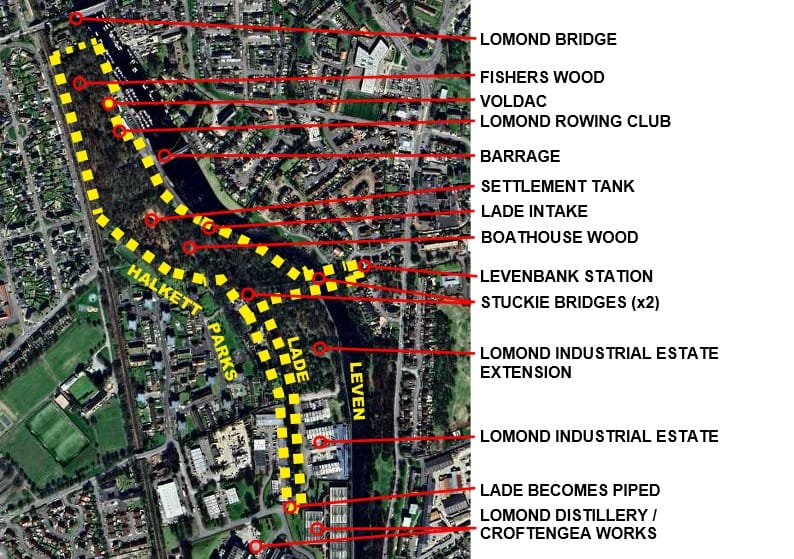
This article focuses on the area within the dashed line where we can find other interrelated historical features.
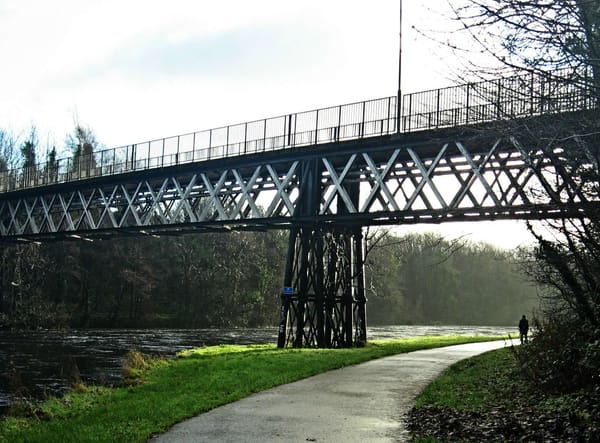
The Stuckie Bridge, or more accurately, the pair of Stuckie Bridges stand prominently.
The name is old Scots for Starling, but referring to Stirling. That is not so much to do with the bird, but what it sounds like.
What is today a popular pedestrian and cycle route was a railway bridge until it closed in 1934.
The line was owned by the Forth and Clyde Junction Railway Company and ran on to Caldarvan, Buchlyvie and Stirling.
To the east side of the Leven there was a small platform that served the Levenbank Print Works. Although there is now housing there (Honeysuckle Lane), you can still see part of the retaining wall and fencing.
Another line ran up to Loch Lomond from Dumbarton, serving some of the textile works on the way.
That was the Caledonia Junction Railway, the two merging alongside Fishers Wood.
At the junction of the two railways there was a small cottage called Rosehead. You can still see the spikes of its iron garden fence.
Alongside that is a drainage ditch which has more significance than a casual glance suggests as it drew dirty drainage water away from the textile works just downstream.
A second channel made of iron crosses the lade just where Heather Avenue reaches the Leven. The textile industries flourished with the ample clear waters from the Leven, but efforts were necessary to avoid contamination along the way.
We have lost all the textile industry related lades along the Leven – except one. Mill Lade.
This one served what is arguably the most important of all the local textile works, that of Croftengea Print Works (which had merged with the Alexandria Works).
This lade leading fresh clean water into that Works remains much as it was in the heyday of what locals call ʻthe Craft.’
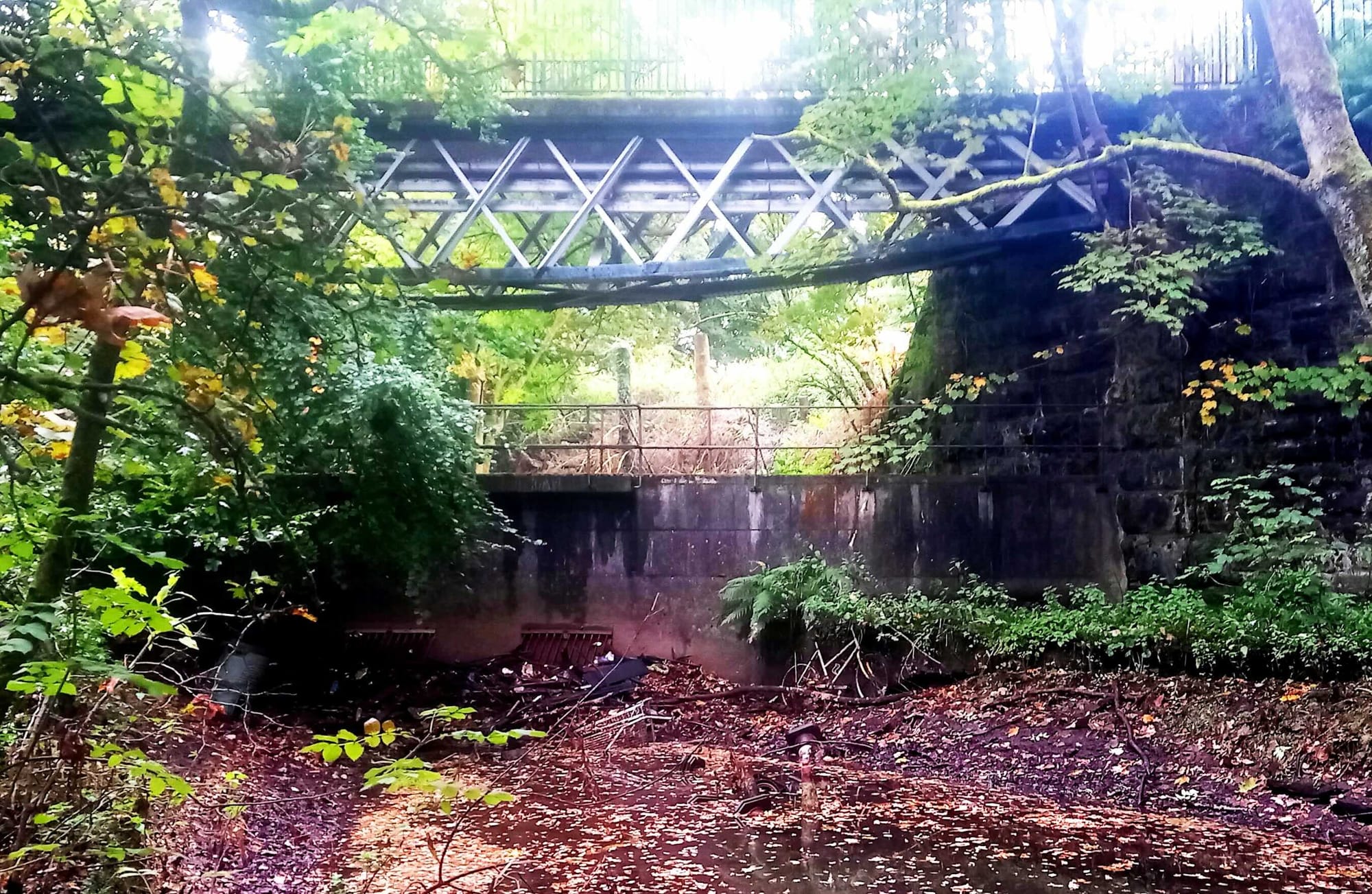
From this point it runs below the Stuckie Bridges where there is a flow control sluice, up to the boundary of Lomond Distillery.
This latter today takes up much of what was an extensive textile works complex and still utilises some of the original buildings.
The lade ducks underground within their fence and re- emerges downstream through a pair of vaulted tunnels.
While it no longer flows as it should, it remains picturesque and a home to many water birds and other creatures. It also serves as a valuable sustainable drainage system catchment (SuDS) which should not be underestimated as we experience more severe weather events, such as flooding, as our climate changes.
It is hoped this article engenders some interest in and respect for these interrelated surviving historical industrial features within the Vale of Leven.
Further information and references are available on the EXPLORE WEST DUNBARTONSHIRE website. Explore West Dunbartonshire | TEXTILE WORKS LADES and RAILWAYS