Hidden Heritage: Unlocking Churchyard Secrets
By Florence Boyle

– 5 min read
By Florence Boyle
It’s a mark of how significant a place Old Kilpatrick was, that it’s the only place of settlement between Glasgow and Dumbarton which appears on a 1595 map of Scotland.
Old Kilpatrick has been a place of human settlement for thousands of years and not only on land, Neolithic people also lived on crannogs (man-made islands) on the Clyde.
Where people lived, they died and Old Kilpatrick parish churchyard was the burial place for generations of locals, a place where the great and the good were laid to rest alongside their neighbours of more modest means, irrespective of denomination.
Before the current church was built in 1812, on the site of a previous medieval church there was an earlier informal place of worship across the road on the site of St Patrick’s Well.
Old Kilpatrick was also an important place of pilgrimage.
Pilgrimage was the medieval equivalent of a holiday where people packed up their belongings, brought their own food and drink and travelled to a place of homage.
And one of those destinations was Kilpatrick - translated from Scots Gaelic, Kilpatrick (CillePhàdraig) means the Church of Patrick.
I’ve been researching the graveyard since the pandemic, and it didn’t take long for a picture to emerge of how varied and important the stories of the people who lived here were and what those stories said about the industrialisation of Scotland in the 19th century, the growth of shipbuilding and immigration from Ireland into the area.
Tucked away in the corner of the graveyard is one of the oldest grave enclosures, containing the remains of the Stirling of Law family, one of the oldest noble families in Scotland, whose roots date back to the 12th century.
The Stirling family were part of Scotland’s landed gentry and various branches owned huge tracts of land across Stirlingshire and Dunbartonshire (including the Edinbarnet estate).
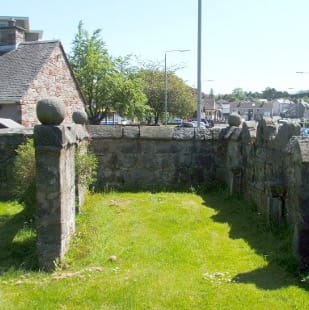
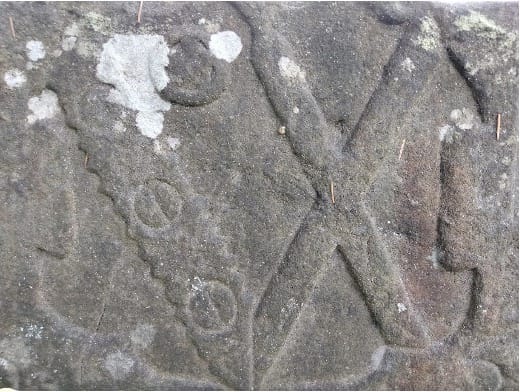
The enclosure is in some state of disrepair, and it looks like it might have had a roof at one point, but it is clearly marked with the family’s heraldic shield.
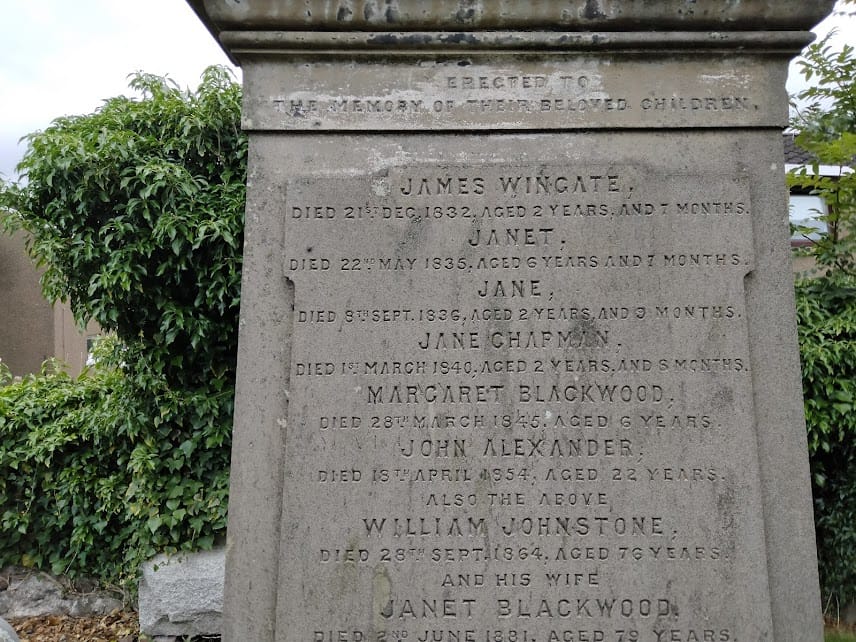
Then there is Captain William Johnstone, “an Old Kilpatrick man”, who died at Olinda Cottage in 1864 aged 76 was Glasgow’s first harbourmaster.
He began the job in 1828 and continued in service until a few weeks before his death. Johnstone oversaw the rapid expansion of Glasgow as one of the most significant ports in Britain and is an important character in the story of Glasgow’s maritime history.
In January 1915 John Halkett, an old soldier was laid to rest with military honours.
Halkett was no ordinary squaddie; he had fought on the Northwest frontier and was awarded the Kabul to Khandar star in recognition of his contribution as part of a hand-picked contingent which marched 320 miles in less than a month in August 1880 to provide relief to soldiers under siege.
Members of the Argyll and Sutherland Highlanders accompanied the cortege, and the awful irony was that these soldiers could only be present because they were stationed in Dumbarton waiting to leave for yet another war.
The Forth and Clyde Canal opened in 1790. The final stretch from Kelvinbridge to Bowling was completed by the Whitworth family, originally from Halifax in Yorkshire. Canal building was a family business and after the Forth & Clyde was completed the family moved on to build the Leeds and Liverpool Canal.
But Robert Whitworth junior met an Old Kilpatrick girl, Jane Fleming, and stayed here. He died in 1802 and is buried in Old Kilpatrick alongside his daughter Mary Ann who died in 1803 and his wife Jane who died in 1807.
Then there were those who remain anonymous.
In the time before fingerprints and DNA, identification of strangers was all but impossible. It may be hard to imagine now but Bowling harbour and the canal were bustling places with ships, from across the world, berthed ready to take on or deposit cargo.
Inevitably there were drownings and accidents, bodies washed up on the shore or retrieved from the canal with nothing to say who they were. These nameless souls were given a decent burial in a common grave.
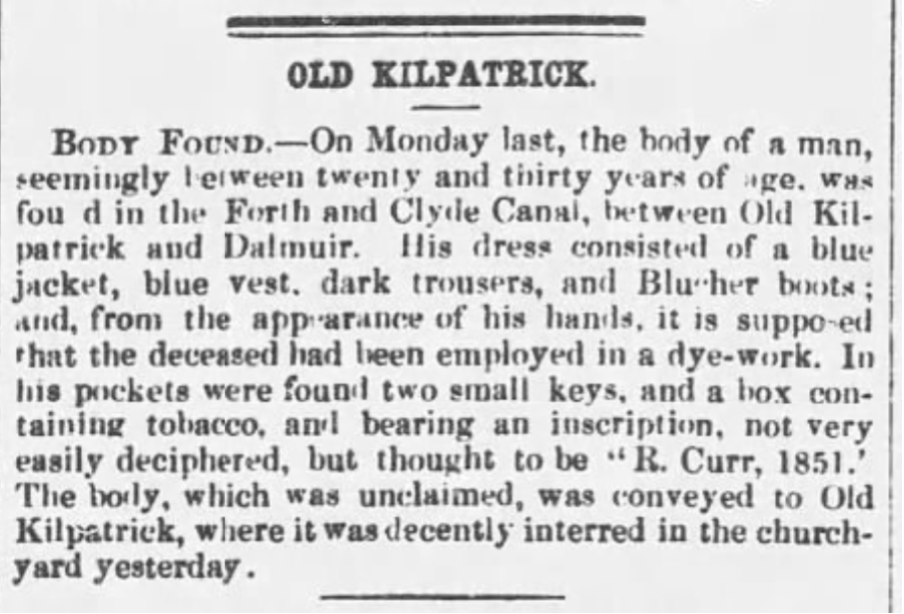
There were others too poor to afford a burial where the parish council stepped in, we know some of their names, but their grave is unmarked.
This is just a small selection of the stories from the graveyard but finding more and locating the graves is difficult because there is no map.
Archaeology Scotland have agreed to accept Old Kilpatrick graveyard (the old graveyard surrounding the Church) into the Adopt-A-Monument scheme. The scheme unlocks access to archaeological expertise on preservation and recording.
In the last few months, the digitised burial records, dating back to the 1870s have become available.
These registers record who is buried in each grave, no matter whether the graves are marked or not or whether their names appear on the gravestones; matched with a map of the graveyard it has potential to unlock many more stories of the people who lived here.
Volunteer training will take place in the Spring, this will teach volunteers basic archaeological recording, digital mapping, and how to assess the condition of gravestones. No previous experience required. Volunteers will acquire valuable heritage skills.
If you are interested in helping unlock local history, please contact Action Old Kilpatrick via their Facebook page.