Local Football the Early Years – An Important Choice
By Brian Wright

– 3 min read
By Brian Wright
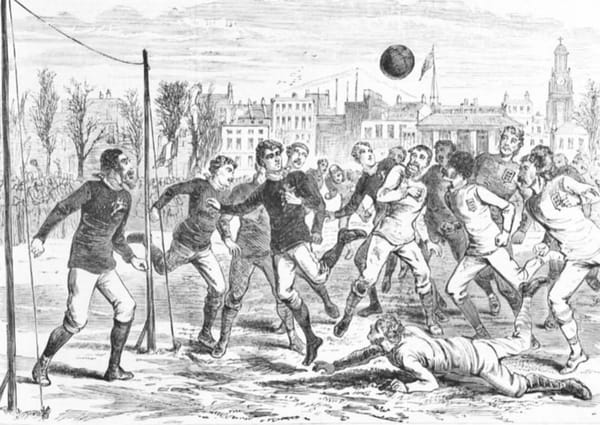
For the world's first officially recognised association football international, played at Partick on 30th November 1872, a team formed from nine clubs representing the separate football associations of London, Nottinghamshire and Sheffield travelled north to face 11 players of Scotland's Queenʼs Park club.
Officially recognised, yes, but Scotland did not yet have any organising body to oversee its game. In truth neither did England, although the London FA regarded itself as pre- eminent.
The English, whose game relied on brute strength, weighed-in an estimated two stones (12.7 kg) heavier than the Scots. Yet, despite this, the encounter ended goalless.
The technical ability and scientific approach of the Scots' was sufficient to cancel- out any benefit which may have lain with their opponents.
From within the crowd, many observers returned home to local towns and villages entranced by the spectacle and determined to establish football clubs of their own.
However, Queen's Park was concerned by the potential effect of the world's forthcoming third rugby international also scheduled to be played in Partick at the West of Scotland Cricket Ground, only a little over three months later; on 3rd March 1873.
Queenʼs Parkʼs concern centred on groups juggling with a decision over which winter sport to adopt - football or rugby. So, the Hampden Park club grasped the nettle and took on the dual role of evangelist and missionary, encouraging clubs to its favoured association code and away from rugby.
Having already faced its neighbouring cricket club, Granville, in a short series of three football challenges, Queenʼs Park wrote to encourage other established cricket clubs in and around Glasgow towards football as a winter sport.
Very keen to make contact with Queenʼs Park was an existing multi-sports club formed of workers from textile factories in Alexandria.
The Vale of Leven club already fielded teams at shinty and cricket and was actively considering winter sport options.
Three weeks after the 1872 St Andrewʼs Day football international in Partick, The Vale arrived to play at municipal Queenʼs Park Recreation Grounds in Crosshill, south of the Glasgow boundary.
It was the first of four instructional challenge matches over 10 weeks in which Queenʼs Park introduced the Alexandria boys to the basics of football; regularly stopping play to explain aspects of the rules.
Consequently, the resulting scores were generally irrelevant but interesting nonetheless.
A 3-0 home victory in Crosshill was followed by successive 0-0 draws in Alexandria and back at Crosshill, before Queenʼs Park won 1-0 in Alexandria on 1 March 1873.
The Vale players were quick learners. The Vale public turned out in numbers. Both were hooked on football as their winter sport.
Dumbarton FC was formed on 23rd December 1872, a few locals having travelled to witness the Vale of Levenʼs initial match with Queenʼs Park.
March 1873 proved to be a defining month in Scottish sport circles.
Following the rugby international on 3rd March, Scotlandʼs rugby-playing clubs formed their national Union to oversee the sportʼs development.
Ten days later, a Scottish Football Association was finally formed upon the Queenʼs Park players arriving home from London and the first return football international against England. Of the SFAʼs initial eight clubs, six were already playing cricket.
A further eight clubs joined the SFA before the first playing of the Scottish Cup beginning in October 1873. Six of those were also cricket- playing clubs.
So, the first Scottish FA Cup draw consisted of the newly encouraged association football sections of 12 cricket- playing clubs, plus Queenʼs Park and three other of Glasgowʼs earliest footballing teams; Callander FC, Rovers FC, and the Alexandra Athletic Club.
The 16 clubs included Dumbarton, Renton and Vale of Leven.
Whilst Renton was also a multi-sports club formed from the villageʼs textile works, Dumbartonʼs origins are held in some doubt.
At least one Scottish cricket historian considers it founded by cricket players. However, no evidence exists that it played cricket thereafter. In fact, it is known to have played against a Dumbarton Cricket & Football Club.
Perhaps the football club we know today had been formed by a break-away group of cricketers.