Women For Women
– 3 min read
Statistics say that West Dunbartonshire is the second worst area in Scotland for domestic violence, or perhaps it's fourth, depends who's telling.
Either way the blight of domestic violence is rife in our area and 83% of those suffering are women.
A further look at the Council's website brings us to the hopeful sounding strategy to “prevent and eradicate gender-based violence” published in 2014, amended 2016, 2023 and 2025.
Therein it states “we recognise that the inequality between men and women is the cause and consequence of this violence and abuse and are committed to taking a gendered approach to
tackling both.”
In 2022 WDC councillors voted unanimously to “maintain funding for the duration of the administration's term.”
One councillor said: “We know West Dunbartonshire has a serious problem with domestic abuse … it is important that they [Women's Aid] know we are behind them … these next five years.”
Excellent news.
Dumbarton and Clydebank Women's Aid thought they were secure until 2027.
But talk is cheap and here actions donʼt just speak louder, they shriek.
In 2024 the proposal to cut funding started again and resulted in the present necessity of closing Clydebank's only outreach and refuge point for women and children facing possibly the worst moment of their lives.
I met with a passionate, dedicated advocate for women's needs and rights, who works with Violence Against Women and the Clydebank peer group Women Supporting Women, Dawn Brennan.
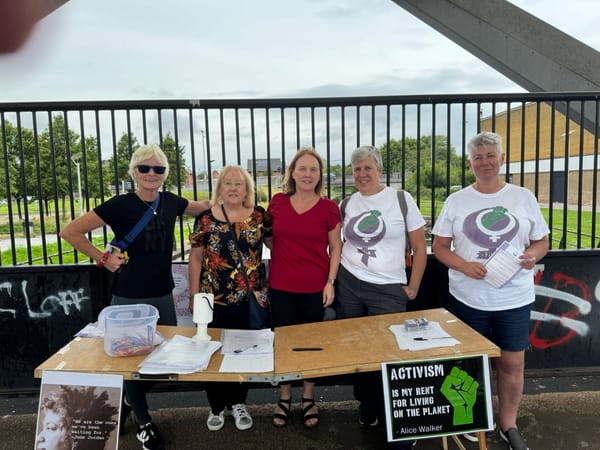
She has campaigned for Womenʼs Aid for 40 years. She and her 77-year-old mum, still have a stall in Clydebank shopping centre to try to save services for future generations.
Dawn tried to explain the complexities of women in need and the challenges facing the groups trying to support them.
“In its way the constant targeting of women and the cuts to the services that support them, is also a form of gender-based violence,” said Dawn.
“It says, loud and clear, women do not count.
“It's a message that empowers abusers by showing them that crimes against women are second rate and punishment – if it comes at all – will be minor.
“It is no use politicians making big statements 'we will end gender-based violence' if the next thing they do attacks women and undermines their ability to escape that violence.”
Dawn talked about the legalities that affect abused women: the balancing of an abusive husband's rights to see his children with the possibility of them being used as leverage against
the woman; the social fear of protests by more vocal groups overcoming the need of vulnerable girls; the cuts in Legal Aid; the extreme complexities of the benefits system; the loss of
neighbourhood police who would know the parties involved in domestic complaints; the need for laws protecting women to be more firmly enforced…
So many things that will put women's needs in second or third place, despite the huge scandals and the deaths.
“The truth is the system is about control and abusers are controllers in the extreme,” said Dawn.
“Then there are social preconceptions and the derogatory labels that are, still today and despite the pretence of a neutrality of views, applied to women and girls.
“There are just so many obstacles in the way of women who need help.
Sometimes it can be dispiriting.” She sighed.
“But we fight on, with whatever the system will give us, then fight for more to be able to do more. That's the way it works.”
So, what is next for women in need in our area?
Dawn's head comes up, her slumped shoulders straighten.
“We fight on trying to get those who hold the purse strings to prioritise women and children, to get politicians to translate talk into fact, to make those involved more understanding.
“Truth is councillors, politicians react to those who make most noise.
“When we asked about funding going to support a golf course instead of the refuge, we were told they [WDC] had received a great many calls about the golf course but not about the refuge.
“The challenge is to get women to fight for themselves.
“The Suffragettes managed it, the WASPI women fought hard, we just need to fight harder, get more women to fight. That's what we'll do.”
I thought it was a very good thing women in need have such passionate women to help them.
If any readers want to get involved in helping women in need, please email Women Supporting Women – [email protected]